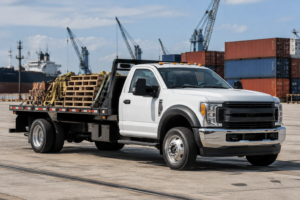

If you’re speccing a new flatbed to pull a heavy trailer, the hitch you choose matters as much as the bed
itself. Fifth wheel and gooseneck hitches both mount in the bed rather than on the bumper, and both handle far
more weight than a bumper-pull setup — but they aren’t interchangeable. At
Star Truck Equipment in Wharton, TX, we build and outfit
flatbed truck bodies for ranching, equipment
hauling, and RV towing across Texas and Louisiana — here’s how the two hitch types compare so you spec the
right one the first time.
How a Gooseneck Hitch Works
A gooseneck hitch uses a ball mounted flush in the bed, directly over or just ahead of the rear axle. The
trailer’s coupler drops down onto that ball from a gooseneck-style neck that arcs up and over the tailgate area.
Because the ball sits low and the connection point is compact, gooseneck setups leave more usable deck space
around the hitch and are the standard choice on ranch, livestock, and equipment flatbeds where the rest of the
bed still needs to haul hay, tools, or gear. Gooseneck trailers are also generally easier to back and maneuver
in tight yards and gates than fifth wheel trailers of comparable size.
How a Fifth Wheel Hitch Works
A fifth wheel hitch uses a large horseshoe-shaped plate mounted higher above the bed, usually on a raised
frame or rail system, that clamps around a kingpin on the trailer. That taller, wider hitch head takes up more
deck real estate and typically needs more custom mounting than a gooseneck ball, but it produces a more stable
connection under heavy vertical loads — the reason fifth wheels dominate heavy RV and large horse-trailer towing.
Fifth wheel setups also tend to tow smoother over rough ground since the pivot point rides higher and articulates
differently than a ball-and-coupler connection.
Which One Should You Spec?
- Ranch, ag, and equipment-hauling flatbeds — a gooseneck hitch keeps the deck open for other cargo and is the industry standard for stock and equipment trailers
- Large fifth-wheel RVs or heavy horse trailers built for kingpin coupling — you need a fifth wheel hitch to match the trailer’s coupler, no substitute works
- Tight yards, gates, or frequent backing into small spaces — gooseneck trailers generally maneuver easier
- Maximum deck space for tools, hay, or gear alongside towing capacity — gooseneck’s low-profile ball wins
- Smoothest ride under a heavy, tall trailer load — a fifth wheel’s higher pivot point often rides better over rough roads
Both hitch types can be built into a new flatbed order or, in many cases, retrofitted onto an existing bed.
Browse our flatbed truck bodies and
truck accessories, or read our related comparison
on gooseneck vs. bumper-pull
hitches if a fifth wheel or gooseneck turns out to be more capacity than you actually need.
Get Your Truck Set Up Right
Star Truck Equipment builds and outfits flatbed and service truck bodies with the hitch configuration your
trailer needs, from our shop in Wharton, TX, serving Texas and Louisiana. Call us at
(979) 532-1486 or browse our
flatbed truck bodies and
truck accessories to get started.