
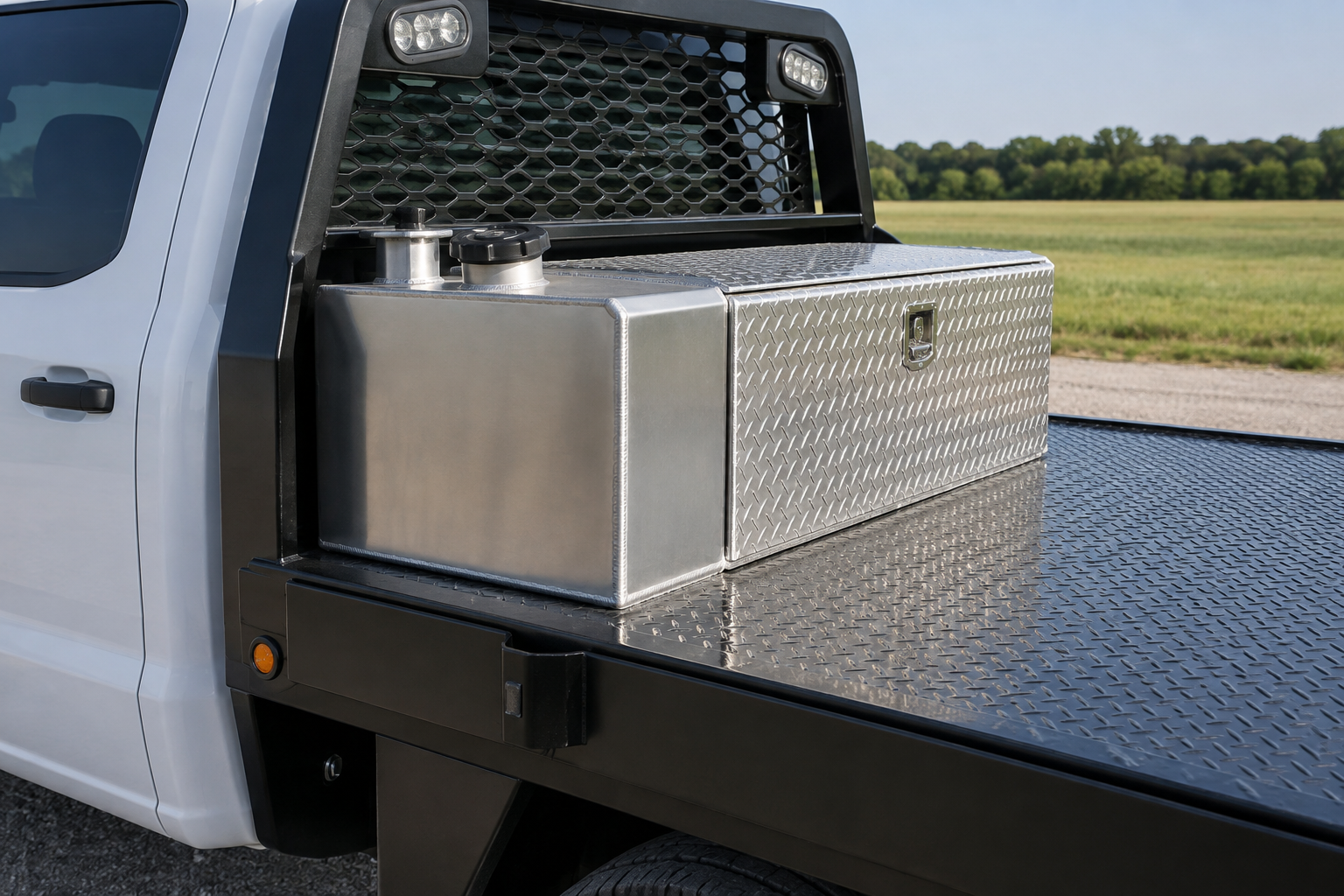
Fleets that run auxiliary fuel on a flatbed have two common ways to spec it: a standalone fuel transfer tank
mounted by itself, or a combo unit that pairs the tank with a toolbox in one bolted assembly. Both keep diesel
or gas on the deck for fueling equipment in the field, but they trade off differently on capacity, tool storage,
and deck space. At Star Truck Equipment in Wharton, TX, we mount
both configurations on flatbed truck bodies
for ranching, oilfield, construction, and ag fleets across Texas and Louisiana — here’s how to decide which one
belongs on your truck.
What a Single Fuel Transfer Tank Offers
A standalone transfer tank is sized purely for fuel capacity — common options run from 50 to 100+ gallons in
a rectangular or L-shaped tank that tucks against the headboard or along a rail. Because the whole unit is
dedicated to fuel, you get more gallons per pound of hardware mounted, which matters on trucks already carrying
a payload close to their rating. It also leaves the rest of the deck open for hay, tools, or equipment that
doesn’t need to live in the same box as your fuel. The tradeoff is that any tools or spill supplies you carry
need their own separate toolbox, eating into deck space anyway.
What a Combo Toolbox/Tank Unit Offers
A combo unit — sometimes called a transfer tank toolbox combo — puts a smaller fuel tank and a lockable tool
compartment in one footprint, usually mounted across the headboard or along one rail. This saves deck space
versus running a separate tank and a separate toolbox side by side, and it keeps fuel hoses, nozzles, funnels,
and rags in the same reachable spot as the tank. The tradeoff is less total fuel capacity for the same footprint
and mounted weight, since part of the box is tool storage rather than fuel volume — for crews that don’t need
80+ gallons between fill-ups, that’s rarely a problem.
Which Setup Fits Your Work?
- Ranch and ag operators fueling tractors and equipment far from a pump — a large standalone transfer tank maximizes gallons carried
- Oilfield and construction crews who need fuel and tools in one reachable spot — a combo unit keeps everything organized without a second box
- Trucks already near their payload limit — a standalone tank delivers more fuel capacity per pound of hardware
- Fleets tight on deck space for other cargo — a combo unit’s single footprint frees up rail and deck room
- Crews that don’t need 80+ gallons at a time — a combo unit’s smaller tank is usually plenty between refills
Either configuration can be specified when your flatbed is built. Browse our
truck accessories and
flatbed truck bodies, or ask about outfitting
your next order with the fuel and toolbox setup that matches how your crew works.
Get Your Truck Set Up Right
Star Truck Equipment builds and outfits flatbed and service truck bodies for ranching, oilfield, construction,
and ag fleets across Texas and Louisiana from our shop in Wharton, TX. Call us at (979) 532-1486
or browse our flatbed truck bodies and
truck accessories to get started.


