Crane Body vs. Service Body: Which One Does Your Work Truck Actually Need?
If you’re upfitting a truck for demanding field work — whether that’s oilfield, construction, utility, or heavy equipment service — you’ve probably faced this question: should I spec a crane body or a service body? Both are serious work platforms. But they serve different jobs, and choosing the wrong one means wasted money and a truck that doesn’t match your workflow.
At Star Truck Equipment in Wharton, TX, we upfit trucks for contractors, oilfield operators, and tradesmen across Texas and Louisiana every day. Here’s a straight-shooting breakdown to help you decide.
What Is a Service Body?
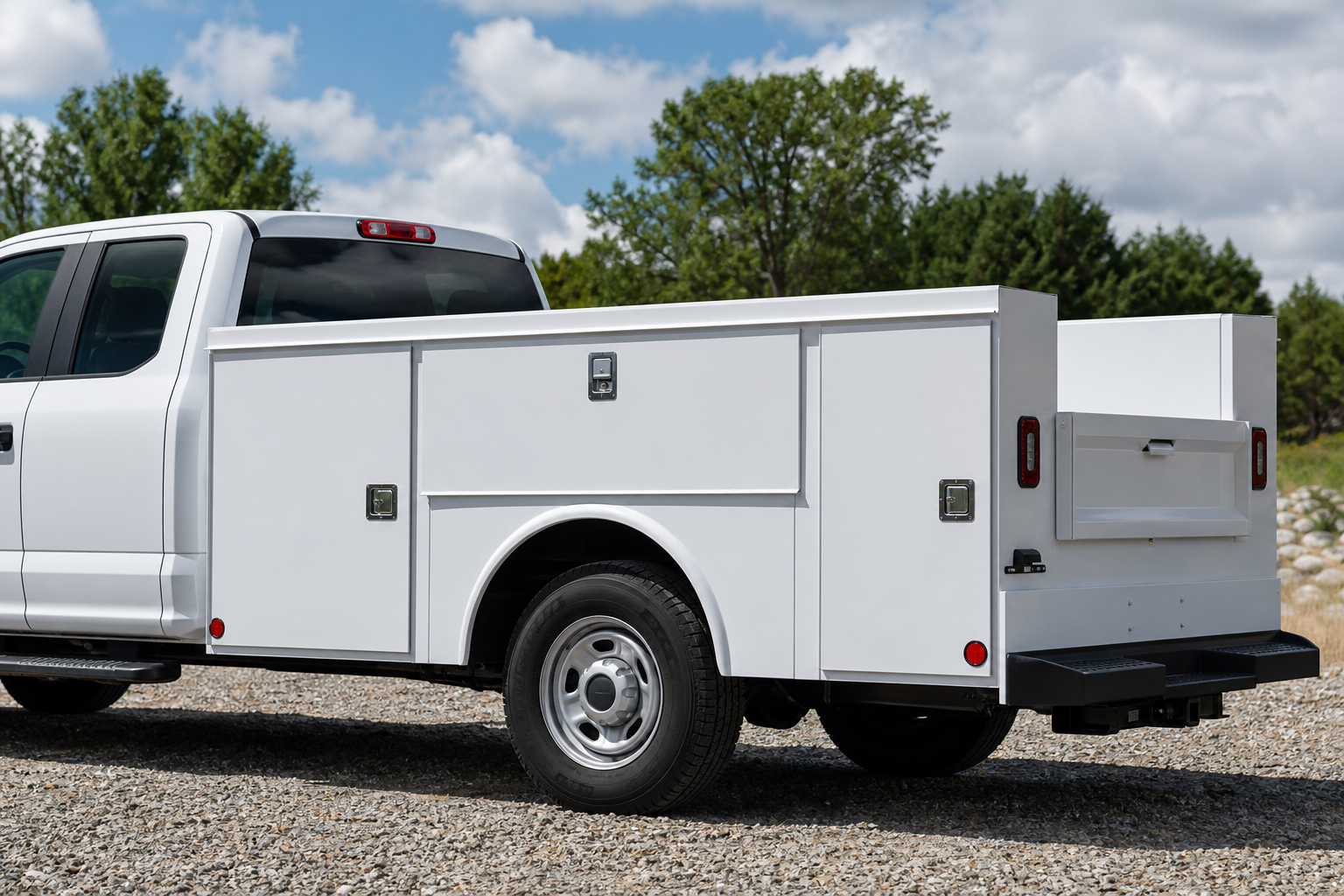
A service body replaces your factory pickup bed with a purpose-built aluminum or steel unit packed with lockable compartments, tool drawers, and organized storage. The goal is maximum parts and tool access from the ground — without digging through a pile of gear in a pickup bed.
Service bodies are ideal for:
- Plumbers, electricians, and HVAC techs who carry a lot of hand tools, fittings, and parts
- Fleet service trucks that travel between jobsites
- Any crew that needs organized storage more than lifting capacity
We carry STI (Service Trucks International) service bodies, which are built specifically for heavy commercial use. STI bodies feature deep compartments, high-strength steel or aluminum construction, and configurations tailored to specific trades. RKI and CM also offer strong service body options depending on your budget and payload needs.
What Is a Crane Body?
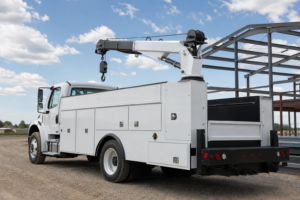
A crane body is a service body that also integrates a truck-mounted crane — usually a knuckle boom or telescoping boom crane mounted at the front or rear of the body. The crane is the centerpiece; the compartments are secondary.
Crane bodies are essential for:
- Setting heavy equipment, reel drums, or pipe sections on jobsites
- Oilfield service work — picking up motors, BOP equipment, and wellhead components
- Utility and electrical companies moving transformers, poles, or cable reels
- Any operation where one or two workers need to safely lift and position loads without a separate crane truck
We spec Tiger Cranes paired with STI crane bodies for customers who need reliable performance and strong dealer support in Texas and Louisiana. Tiger’s lineup covers everything from compact 3-ton units to heavy-duty 17+ ton models suited for serious oilfield and construction applications.
Key Differences at a Glance
| Feature | Service Body | Crane Body |
|---|---|---|
| Primary function | Organized tool & parts storage | Lifting + organized storage |
| Crane included | No | Yes (knuckle boom or telescoping) |
| Weight | Lighter — more payload for cargo | Heavier — crane adds significant weight |
| Cost | Lower upfront cost | Higher — crane adds $10K–$40K+ |
| Chassis requirement | F-250 to F-550, Ram 2500–5500 | Typically F-450/F-550, Ram 4500/5500 minimum |
| Best for | Trades, fleet service, parts delivery | Oilfield, utilities, heavy equipment service |
Which Chassis Do You Need?
Crane bodies require more truck. A typical crane body setup — body weight plus the crane — can add 3,000 to 6,000+ lbs before you load a single tool. That means you almost always need a cab-and-chassis platform like a Ford F-450, F-550, Ram 4500, or Ram 5500 to handle the GVW and maintain legal payload capacity.
Service bodies are more flexible. A well-spec’d Ram 3500 or Ford F-350 can carry a full service body with room to work, though heavier steel service bodies may push you toward a 1.5-ton or 2-ton chassis for larger compartment configurations.
Can You Add a Crane to a Service Body Later?
Technically yes, but it’s rarely cost-effective. Service bodies aren’t structurally reinforced for crane mounting loads, and adding a crane later typically requires structural modifications, rewiring for PTO hydraulics, and potentially replacing the body altogether. If lifting is even a possibility in your workflow, build the crane in from the start — the total cost is almost always lower than a retrofit.
Real-World Scenarios
Oilfield pumper truck: Crane body. You need to pull motors, move equipment, and work solo at remote locations. A service body alone leaves you dependent on rented crane trucks or waiting on another crew.
Commercial electrician fleet truck: Service body. You’re carrying conduit, wire, hand tools, and testing equipment. The organized compartments keep your crew efficient on every call without the added weight and cost of a crane.
Utility company line crew: Crane body. Transformers, cable drums, and pole hardware need to be lifted — often in tight spaces. The crane is non-negotiable.
Plumbing service truck: Service body. Pipe, fittings, power tools, and inspection equipment fit perfectly in a well-organized STI or CM unit.
Heavy equipment dealer service truck: Crane body. When you’re servicing dozers, excavators, or compactors in the field, you need to be able to pull and set components that a person can’t lift alone.
Talk to a Specialist Before You Spec
Getting the body right the first time saves thousands down the road. At Star Truck Equipment, we work through the details with you — payload requirements, chassis selection, crane tonnage if needed, compartment layout, and hydraulic PTO setup — before we ever place an order.
We’re located at 2507 County Rd 231, Wharton, TX 77488 and serve customers across Texas and Louisiana. Whether you’re in Houston, Victoria, Corpus Christi, Beaumont, Lake Charles, Baton Rouge, or anywhere in the region — we’ll help you spec the right truck body for the job.
Give us a call at (979) 532-1486 or visit our service bodies page and crane bodies page to see what we have available. Whether you need an STI service body for a plumbing fleet or a Tiger Crane setup for oilfield work, we’ll get your truck ready for the job.